
Annexin A1 expression in Lupus Nephritis
DOI:
https://doi.org/10.62438/tunismed.v102i12.5005Keywords:
Annexin A1, Immunostaining , Lupus nephritis , glomerular proliferationAbstract
Introduction: Lupus nephritis (LN) is an immune complex glomerulonephritis, caused by systemic lupus erythematosus. It is associated with an increase of morbidity and mortality. In LN, the immune responses dysregulation is one of the crucial pathogenic pathways. Annexin A1 (AnxA1), as an anti-inflammatory mediator, plays a critical role in immune responses, in addition to a variety of pathological processes.
Aim: This study aimed to evaluate the AnxA1 expression in renal tissues, in order to explore its potential role in LN pathogenesis.
Methods: AnxA1 expression was performed by immunohistochemistry staining in renal biopsies of 24 LN patients compared to 8 controls.
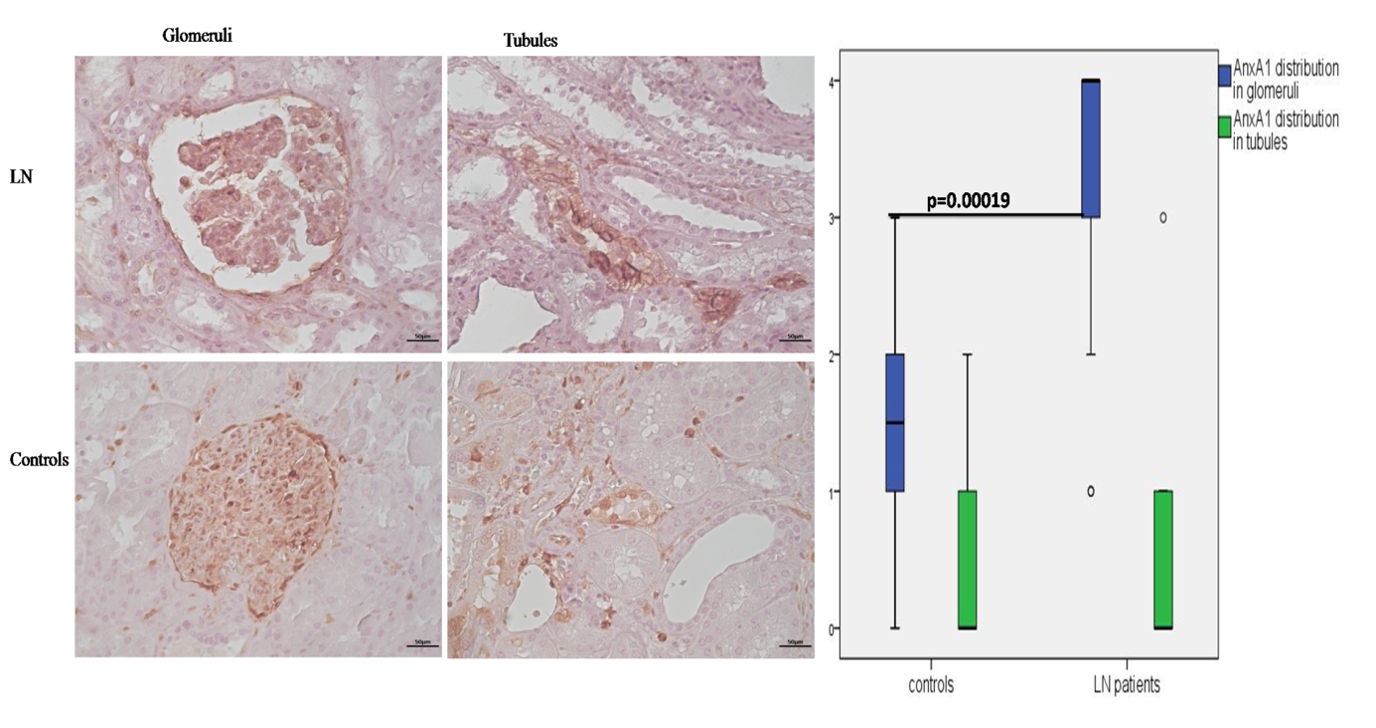
Results: LN patient’s biopsies showed an increased distribution of AnxA1 in glomeruli compared to controls (p=0.00019). When comparing AnxA1 expression in different LN classes, a high AnxA1 intensity score was positively correlated with glomerular proliferation.
Conclusion: Our data suggest AnxA1 as a useful marker to differentiate between severe proliferative and non severe proliferative classes of LN.
Downloads
References
Tecklenborg J, Clayton D, Siebert S, et al. The role of the immune system in kidney disease. Clin Exp Immunol. 2018 ; 192(2):142-150.
Kurts C, Panzer U, Anders HJ, et al. The immune system and kidney disease: basic concepts and clinical implications. Nat Rev Immunol. 2013 Oct; 13(10):738-53.
Robyn C, Carolyn J. K. Immune-mediated renal disease. Immunologic disorders. 2003. DOI: http://doi.org/10.1067/mai.2003.126
Manole C, Inimioara M C, Isabela S, et al. Manifestations of Systemic Lupus Erythematosus. Maedica (Bucur). 2011 Oct; 6(4): 330–336.
Desmond Y.H. Yap, Colin S.O. Tang, Maggie K.M. Ma, et al. Survival analysis and causes of mortality in patients with lupus nephritis. Nephrology Dialysis Transplantation. 2012
Kiremitci S, Ensari A. Classifying lupus nephritis: an ongoing story. ScientificWorldJournal. 2014;2014:580620. doi:10.1155/2014/580620
Jan J W, Vivette DD, Melvin MS et al. The classification of glomerulonephritis in systemic lupus erythematosus revisited. J Am Soc Nephrol. 2004;15(2):241-50. Doi:10.1097/01.asn.0000108969.21691.5d.
Podolska MJ, Biermann MH, Maueröder C, et al. Inflammatory etiopathogenesis of systemic lupus erythematosus: an update. J Inflamm Res. 2015;8:161-171. 2015 Aug 20. doi:10.2147/JIR.S70325
US. Gaipl, A. Sheriff, S. Franz et al. Inefficient Clearance of Dying Cells and Autoreactivity. Curr Top Microbiol Immunol. 2006 ;305 :161-76. doi :10.10007/3-29714-6_8
Shuk-Man Ka, Pei-Yi T, Tai-Kuang C. Chao, et al. Urine Annexin A1 as an Index for Glomerular Injury in Patients. Dis Markers, 2014;2014:854163. Doi:10.1155/2014/854163
Michelle A S, Juliana PV, Mauro MT, et al. Annexin A1 and the Resolution of Inflammation: Modulation of Neutrophil Recruitment, Apoptosis, and Clearance. Journal Immunol Res. 2016;2016:8239258. Doi: 10.1155/2016/8239258.
Mathias U, Per O, Linn F, et al.Towards a knowledge-based Human Protein Atlas. Nature Biotechnology .2010 ; 28, 1248–1250
. Madeeha HS, Egle S. Annexin A1: Uncovering the Many Talents of an Old Protein. Int J Mol Sci.2018; 31;19(4):1045. Doi: 10.3390/ijms19041045
Nesrine E, Raouia F, Lobna A, et al.The Increased Expression of Toll-Like Receptor 4 in Renal and Skin Lesions in Lupus Erythematosus. Journal of Histochemistry & Cytochemistry, 2017;1–10.
D.Geoffrey V, Abdelghani T, Ajeetkumar G et al. Quantitative comparison of immunohistochemical staining intensity in tissues fixed in formalin and Histochoice. Anal Cell Pathol.1997; 15(2):119-29
Gareth SD. P, Massimo C, Rodrigo A L, et al. Identification of AnnexinA1 as an Endogenous Regulator of RhoA, and Its Role in the Pathophysiology and Experimental Therapy of Type-2 Diabetes. Front Immunol. 2019; 27;10:571. Doi: 10.3389/fimmu.2019.00571
Xiao-Feng B, Xiao-Guang N, Ping Z, et al. Overexpression of annexin 1 in pancreatic cancer and its clinical significance. World J Gastroenterol: 2004;15;10(10):1466-70.doi: 10.3748/wjg.v10.i10.1466
Fatma D, Hend H, Olfa A, et al. Annexin A1 and its receptor gene polymorphisms in systemic lupus erythematosus in the Tunisian population. Clinical Rheumatology. 2022. Doi: 10.1007/s10067-022-06057-7
Alice B, Augusto V, Maurizio B, et al. Multi-antibody composition in Lupus nephritis: Isotype and antigen specificity make the difference. Autoimmun Rev. 2015; 14(8):692-702. Doi:10.1016/j-autrev:2015.04.004
Michael S, Michelle B F, Andreas Stefani, et al. Annexin-1 and Peptide Derivatives Are Released by Apoptotic Cells and Stimulate Phagocytosis of Apoptotic Neutrophils by Macrophages. Immunol. 2007;178 (7) 4595-4605.
Nowling TK, Gilkeson GS. Mechanisms of tissue injury in lupus nephritis. Arthritis Res Ther. 2011;13(6):250. doi:10.1186/ar3528
Barrera García A, Gómez-Puerta JA, Arias LF, et al. Infiltrating CD16+ Are Associated with a Reduction in Peripheral CD14+CD16++ Monocytes and Severe Forms of Lupus Nephritis. Autoimmune Dis. 2016;2016:9324315. doi:10.1155/2016/9324315
Feng Y, Mark H, Richard G, et al. Redefining lupus nephritis: Clinical implications of pathophysiologic subtypes. Nat Rev Nephrol. 2017;13(8):483-495.
Goulding NJ, Godolphin JL, Sharland PR, et al. Anti inflammatory lipocortin 1 production by peripheral blood leucocytes in response to hydrocortisone. Lancet,16;335(8703):1416-8, 1990.
Mauro P, Fulvio D. Annexin A1 and glucocorticoids as effectors of the resolution of inflammation. Nat Rev Immunol, 9(1):62-70, 2009.
Haddouk S, Hachicha H, Marzouk S, et al. Anti-nucleosome antibodies may predict lupus nephritis and severity of disease in systemic lupus erythematosus.Indian Journal of Rheumatology. 2010; 165-170.
Diego M S, Jonay P, Miguel F B, et al.Targeting of regulated necrosis in kidney diseaseAnálisis dirigido de la necrosis regulada en la enfermedad renal. Nefrologia. 2018; 125-135.
Ana BS, Beatriz S, Marta R, et al. Mechanisms of Renal Apoptosis in Health and Disease. J Am Soc Nephrol. 2008; 19(9):1634-42.
Esmeralda C R, Raul F P, Catalina MC, et al. Kidney Injury Marker 1 and Neutrophil Gelatinase-Associated Lipocalin in Chronic Kidney Disease. Nephron. 2017;136:263-267.
Vago J. P., Nogueira C. R., Tavares L. P., et al. Annexin A1 modulates natural and glucocorticoid-induced resolution of inflammation by enhancing neutrophil apoptosis. Journal of Leukocyte Biology. 2012;92(2):249–258. doi: 10.1189/jlb.0112008.
Additional Files
Published
Issue
Section
Categories
License
Copyright (c) 2024 La Tunisie Médicale

This work is licensed under a Creative Commons Attribution-NonCommercial-NoDerivatives 4.0 International License.
