
Inherited epidermolysis bullosa in Dakar : Descriptive cross-sectional study of 36 cases
DOI:
https://doi.org/10.62438/tunismed.v104i04.6176Keywords:
Inherited epidermolysis bullosa, dystrophic inherited epidermolysis bullosa, infection, cancer, DakarAbstract
Introduction: The aim of this study was to determine the frequency, clinical forms and complications of Inherited epidermolysis bullosa in Dakar.
Methodology: we conducted a descriptive cross-sectional study with data collection from medical records of patients followed up for Inherited
epidermolysis bullosa in the dermatology department of the Albert Royer Children's Hospital over an 11-year period.
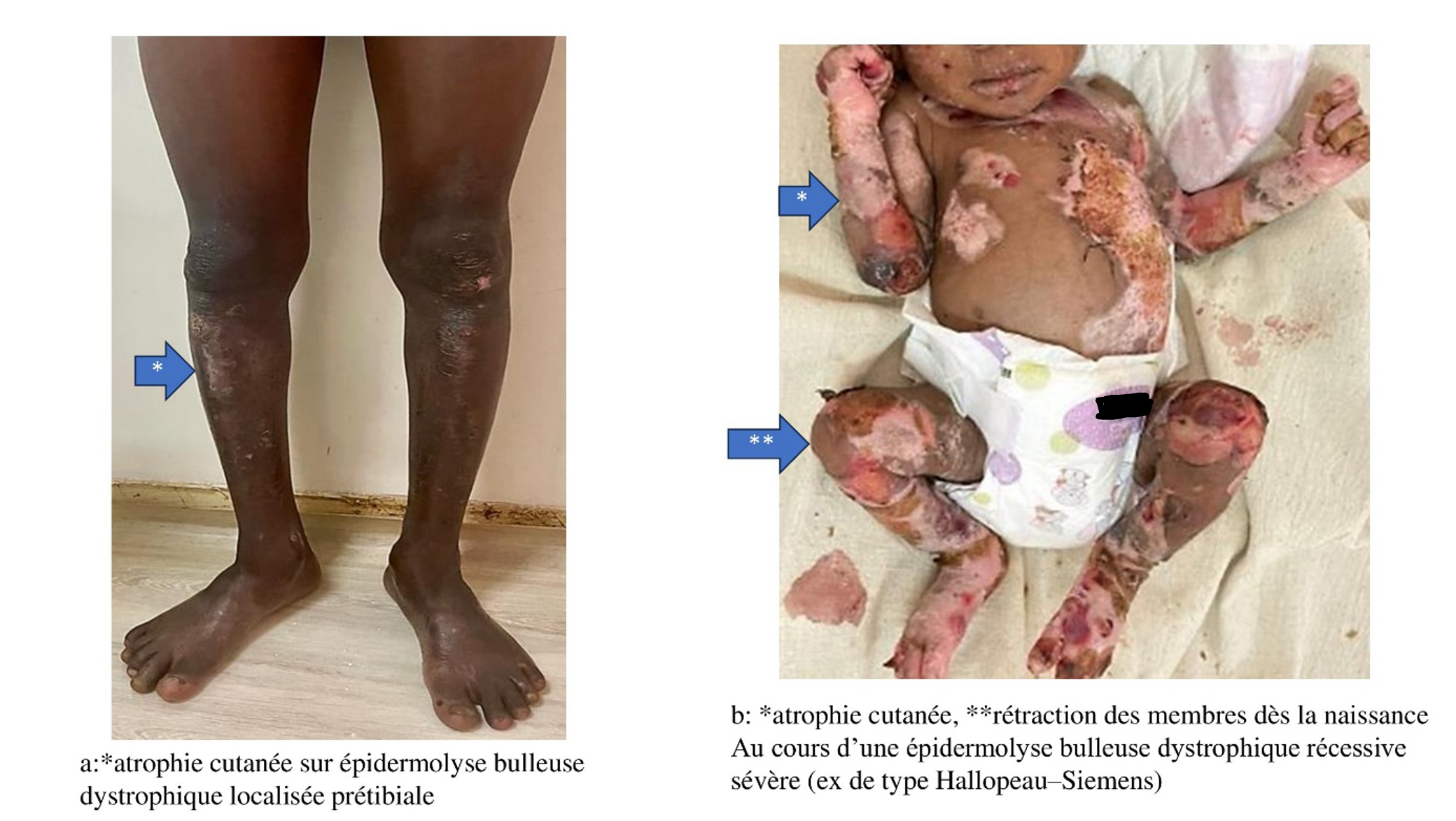
Results: 36 patients were registered, representing a hospital frequency of 0.16% and a sex ratio of 0.6. Clinical forms were: dystrophic in 44%,
simple in 33%, junctional in 17%, associated with congenital cutaneous aplasia in 6% (Bart's syndrome), Kindler's syndrome in 6%. Complications
occurred in 39% of cases, including infections in 28%, hemodynamic disorders in 17% and digestive complications in 11%. Death was recorded in
11% as a result of infectious and anemia.
Conclusion: We report a series of 36 cases of inherited epidermolysis bullosa, representing a hospital frequency of 0.16%. The most frequent
clinical form is dystrophic. Complications are mainly infectious and hemodynamic. We emphasize the importance of follow-up in these patients,
given the risk of skin cancer associated with the long-term prognosis of scars in dystrophic forms.
Downloads
References
Hernandez-Martín A, Aranegui B, Escámez MJ, de Lucas R, Vicente A, Rodríguez-Díaz E et coll. Prevalence of dystrophic epidermolysis bullosa in Spain: a population-based study using the 3-source
capture-recapture method. Evidence of a need for improvement incare. Actas Dermosifiliogr. 2013 Dec;104(10):890-6
Kiritsi D, Nyström A. Recent advances in understanding and managing epidermolysis bullosa. F1000 Res. 2018 ; 17;7, doi:
12688/f1000research.14974.1.
Has C, Bauer JW, Bodemer C, Bolling MC, Bruckner-Tuderman L, Diem A, et coll. Consensus reclassification of inherited
epidermolysis bullosa and other disorders with skin fragility. Br J Dermatol. 2020 ; 183(4):614-627
Chiaverini C, Bourrat E, Mazereeuw-Hautier J, Hadj-Rabia S, Bodemer C, Lacour JP. Épidermolyses bulleuses héréditaires :
protocole national de diagnostic et de soins (PNDS) Ann Dermatol Venereol. 2017;144(1):6-35
Intong LR, Murrell DF. How to take skin biopsies for epidermolysis bullosa. Dermatol Clin. 2010;28(2):197-200
Fine JD. Inherited epidermolysis bullosa. Orphanet Journal of rare diseases 2010; 5: 12-17
Karabinta Y, Gassama M, Diakité B, Guindo B, Keita A, Thiam H, et al. Epidemiological, Clinical and Therapeutic Profile of
Genodermatoses in Mali. J Dermatol Res Ther 2020, 6:090
Korbi M, Aounallah A, Laroussi N, Belajouza C, Ghariani Fetoui N, Ghariani N, et al. Particularités épidémio-clinique et génétique de l’épidermolyse bulleuse héréditaire : à propos d’une série de 34 cas au centre Tunisien. Ann Dermatol Vénéréologie. 2015 ;142(12, Supplement): S591.
Bennouna N, Elfetouaki F, Hali F, Chiheb S. Épidermolyse bulleuse héréditaire au Maroc. Ann Dermatol Vénéréologie - FMC. 2021;1(8, Supplement 1):A232-A233.
Marchili MR, Spina G, Roversi M, Mascolo C, Pentimalli E, Corbeddu M, et coll. Epidermolysis Bullosa in children: the central role of the pediatrician. Orphanet J Rare Dis. 2022;17(1):147.
Chaumon S, Bodemer C, Greco C. Comprendre la non-observance des prémédications antalgiques à base d’opioïdes lors des soins des enfants atteints d’épidermolyse bulleuse héréditaire. Douleurs Éval
- Diagn - Trait. 2022;23(1):14-24.
Has C, Hess M, Anemüller W, Blume-Peytavi U, Emmert S, Fölster- Holst R, et coll. Epidemiology of inherited epidermolysis bullosa in Germany. J Eur Acad Dermatol Venereol. 2023;37(2):402-410.
Tadini G, Gualandri L, Colombi M. The italian registry of hereditary epidermolysis bullosa GIORNALE ITALIANO DI DERMATOLOGIA E VENEREOLOGIA. 2005 ; 140: 359-372
Gear R, Poke G, Neas K, Finnigan J, Cassidy S, Forsyth D, et coll. Epidemiological, clinical, pathological and genetic characteristics of epidermolysis bullosa in New Zealand. Australas J Dermatol. 2022 ; 63(1) : 62-67
Has C, Hess M, Anemüller W, Blume-Peytavi U, Emmert S, Fölster- Holst R, et coll. Epidemiology of inherited epidermolysis bullosa in Germany. J Eur Acad Dermatol Venereol. 2023;37(2):402-410
Martinez-Moreno A, Ocampo-Candiani J, Alba-Rojas E. Epidermolysis bullosa with congenital absence of skin: Review of
the literature. Pediatr Dermatol. 2020;37(5):821-826.
Yavuz Y, An I, Yazmaci B, Akkus Z, Ortac H. Evaluation of Clinical and Oral Findings in Patients with Epidermolysis bullosa. Medicina (Mex). 2023;59(7):1185.
Montaudié H, Chiaverini C, Sbidian E, Charlesworth A, Lacour JP. Inherited epidermolysis bullosa and squamous cell carcinoma: a systematic review of 117 cases. Orphanet J Rare Dis. 2016;11(1):117
Cantrelle P. L’endogamie des populations du Fouta Sénégalais. Population. 1960;15(4):665-676
Mariath LM, Santin JT, Schuler-Faccini L, Kiszewski AE. Inherited epidermolysis bullosa: update on the clinical and genetic aspects. An Bras Dermatol. 2020 ; 95(5):551-569.
Fine J-D. Epidemiology of Inherited Epidermolysis Bullosa Based on Incidenceand Prevalence Estimates From the National Epidermolysis Bullosa Registry. JAMA Dermatol. 2016;152(11):1231-1238.
Additional Files
Published
License
Copyright (c) 2026 La Tunisie Médicale

This work is licensed under a Creative Commons Attribution-NonCommercial-NoDerivatives 4.0 International License.
